Golden K Hypothesis (GKH)
One field. One geometry.
Many phenomena.

Step inside to explore potential answers to some of the most compelling puzzles in modern science.
If you are searching for solutions to the riddles that challenge our current scientific understanding, you have come to the right place
Below is a list of my papers.
A. The Golden K Hypothesis: Axiomatic Synthesis, Emergent Dynamics, and Phenomenology
Description: This paper presents the Golden K Hypothesis, a theoretical framework where spacetime, particles, and forces emerge from the dynamics of a single complex scalar field on a pregeometric, quasicrystalline substrate. The theory derives gravity and quantum mechanics as emergent phenomena and generates concrete, falsifiable predictions that distinguish it from the Standard Model.
B. Unification of Fundamental Interactions as Emergent Regimes of a Single Geometric Field in the Golden K Hypothesis
Description: This article presents a comprehensive analysis of how the four fundamental forces of nature emerge as different dynamic regimes of a single, underlying complex scalar field. The framework demonstrates how gravity arises from the field’s amplitude while gauge interactions arise from its phase, allowing for the derivation of fundamental constants and particle masses from geometric principles.
C. Emergent Reality from a Golden Code: Axioms and Phenomenology of the Golden K Hypothesis
Description: This report provides a deep philosophical analysis of the Golden K Hypothesis, examining it as a framework where all observable reality emerges from a single, information-rich geometric substance. The analysis explores the theory’s pregeometric source code, its novel concept of “dynamic causality,” and its ambitious connections to deep mathematical truths, computational complexity, and the nature of consciousness.
D1. Dynamic Causality in a Fractal Spacetime: The Golden K Framework
D2. Stability and Physical Consequences of Dynamic Causality in a Fractal Spacetime
Description: This pair of papers provides the complete mathematical formulation and proof of stability for the Golden K Hypothesis (GKH), a framework centered on the principle of “Dynamic Causality”. The first document, Dynamic Causality in a Fractal Spacetime, meticulously derives the theory’s governing equations from a variational principle, showing how a single complex field naturally separates into two regimes: emergent gravity described by the field’s amplitude, and quantum phenomena governed by its phase. The second document,Stability and Physical Consequences, builds upon this by rigorously proving the mathematical and physical stability of the entire formalism. It demonstrates that the GKH vacuum is absolutely stable and that the emergent solitonic particles are protected from decay, providing the necessary foundation for the theory’s physical predictions, such as a log-periodic particle mass spectrum dictated by a new conserved charge. Together, the papers establish a self-consistent and stable theoretical framework where the laws of physics are not fixed but co-evolve with the state of the universe itself
E1. The Mass Spectrum of the Standard Model from Discrete Scale Symmetry in a Fractal Spacetime
E2. The Flavor Puzzle and Precision Tests of the Standard Model from E8 Geometry in the Golden K Hypothesis
E3. The Standard Model as a Geometric Eigenvalue Problem: A Complete Solution from the E8 Quasicrystal in the Golden K Hypothesis
Description: This collection of papers details the Golden K Hypothesis (GKH), a theory that solves the Standard Model’s parameter puzzle by deriving physical constants from the geometry of the E8 lattice. The work progresses logically across the documents, first establishing the foundation of GKH by deriving a universal mass formula from a “Discrete Scale Symmetry” which successfully calculates the entire spectrum of particle masses using only the electron’s mass as a single calibration point. The framework is then extended to derive the CKM and PMNS flavor mixing matrices from the same geometric principles without free parameters, also providing solutions for precision test anomalies like the muon g-2 and making falsifiable predictions for new particles at the LHC. The theory culminates by introducing the “Icosahedral 60-Map,” a unifying geometric object that organizes all particles and constants, presenting the Standard Model’s parameters not as arbitrary inputs, but as computable eigenvalues of the underlying E8 structure and framing it as a complete and parameter-free theory.Within the Golden K Hypothesis (GKH), the chirality of the weak interaction is an emergent geometric phenomenon, not a fundamental postulate. The weak force (SU(2)L) arises from specific two-soliton configurations (the W/Z bosons). Fermions (solitons) can exist in various states defined by their internal “phase orientation.” Only solitons with one specific phase orientation—the “left-handed” state—can form an SU(2)L doublet. This specific orientation geometrically “fits” the two-soliton structure of the weak bosons, allowing it to couple and interact. All other phase orientations cause the fermion to remain an SU(2)L singlet (the “right-handed” state), which is geometrically incompatible and thus does not couple to the weak force. Therefore, parity violation is a necessary consequence of a topological “lock and key” mechanism, where the interaction is determined by the soliton’s geometric, phase-based state.
F. The Fine-Structure Constant as an Emergent Property of a Pregeometric E8 Universe: A Critical Analysis of the Golden K Hypothesis
Description: This report presents a rigorous analysis of the fine-structure constant, proposing a formula derived from the geometric invariants of the Golden K Hypothesis’s E8 pregeometric universe. The derived value is successfully tested against high-precision experimental data at both low and high energy scales, providing a geometric explanation for the constant’s “running” and showing remarkable agreement.
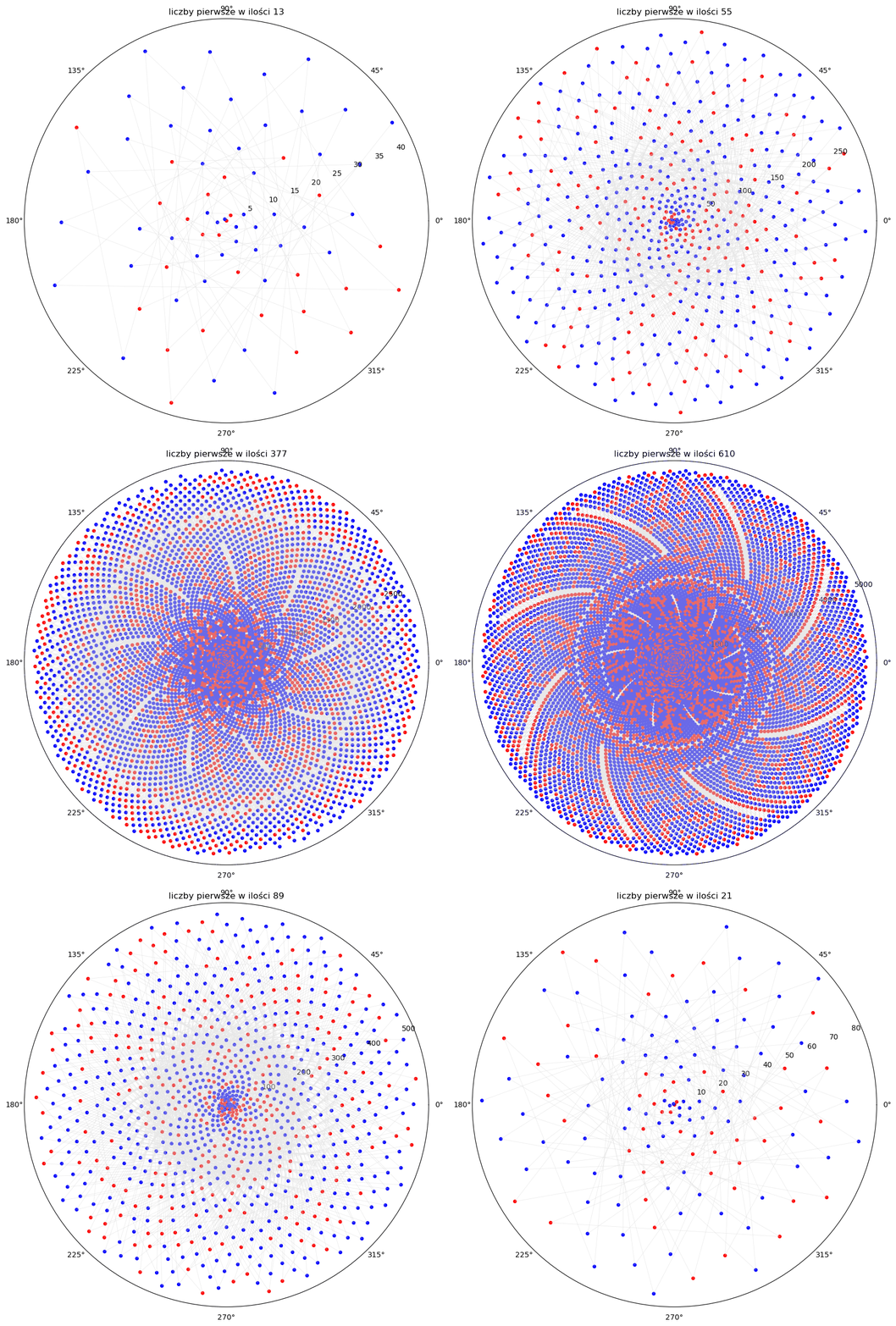
G1. Formal Derivation of the Riemann Hypothesis from the Axiomatic Apparatus of the Golden K Hypothesis
Description: This paper presents a formal mathematical proof of the Riemann Hypothesis, derived step-by-step from the axioms and physical principles of the Golden K Hypothesis. The proof identifies a physical operator within the theory whose spectral properties are shown to be identical to the Riemann zeta function, reformulating the hypothesis as a necessary condition for a stable, non-dissipative universe.
G2. A Unified Geometric Framework for the Millennium Problems: An Analysis of the Golden K Hypothesis
Description: This paper analyzes how the Golden K Hypothesis provides a single, unified geometric framework to resolve four of the Clay Millennium Problems. It demonstrates how the theory’s core principles, such as a fundamental physical scale and a dichotomy between local and non-local dynamics, provide physical solutions to the Yang-Mills mass gap, Navier-Stokes smoothness, and the P vs NP problem.
H. The Golden K Hypothesis: A Unified Structure of Reality Emergent from a Pregeometric Substrate
Description: This report presents the Golden K Hypothesis, a theoretical framework where all physical reality—spacetime, particles, and forces—emerges from the dynamics of a single “Phason Field” on a quasicrystalline substrate derived from the E8 lattice. The theory’s three core postulates (Discrete Scale Symmetry, the Primacy of the Golden Length, and the fractal nature of spacetime) provide a basis for deriving gravity and quantum mechanics as emergent phenomena and generate concrete, falsifiable predictions.
I. A Holistic Synthesis of Reality: From the Golden K Hypothesis to a Unified Theory of Fundamental Problems
Description: This paper presents a holistic synthesis of the Golden K Hypothesis, framing it as a complete theoretical system where all of reality emerges from the pregeometric E8 lattice. The framework is then applied to offer unified solutions to fundamental problems across physics and mathematics, including a physical proof of the Riemann Hypothesis and a geometric interpretation of the P vs NP problem.
J. Cosmological and Fundamental Consequences of the Golden K Hypothesis: A Synthesis of Emergent Spacetime, Matter, and Time
Description: This monograph details the complete cosmological implications of the Golden K Hypothesis, a framework where all physical constants, particles, and interactions emerge as geometric eigenvalues of a single field evolving on an E8-derived substrate. The theory’s core principle of “Dynamic Causality” is shown to generate the four fundamental forces, while the formalism is also used to define a fundamental arrow of time and axiomatically exclude causal time travel.
K. The Theory of One: The Ultimate Synthesis of the Golden K Hypothesis
Description: This document presents the Golden K Hypothesis as the “Theory of One,” a complete and final theory of physics that claims to provide a deterministic and parameter-free description of reality. The core idea is a philosophy of “Geometric Monism,” where the entire universe—spacetime, particles, forces, and physical laws—emerges from the dynamics of a single fundamental substance called the Phason Field. This field’s behavior is dictated by a pregeometric “source code” derived from the unique mathematical properties of the 8-dimensional E8 lattice. The theory is built upon a foundation of three logically necessary axioms that are not postulated but are shown to be inevitable consequences of projecting the E8 structure into our three-dimensional world. These principles are the fractal nature of spacetime, a Discrete Scale Symmetry governed by the golden ratio, and the existence of a fundamental minimum length that makes the theory finite. The mathematical engine of the theory is the principle of “Dynamic Causality,” a feedback loop where the state of the universe actively co-creates the physical laws that govern it through a novel variable-order fractional calculus. From this foundation, the theory purports to explain all of known physics as emergent phenomena. The four fundamental interactions are shown to be merely different dynamical regimes of the single Phason Field. The entire Standard Model of particle physics is reframed as a solved “geometric eigenvalue problem.” A universal mass formula, calibrated solely by the mass of the electron, successfully predicts the masses of all known particles with profound precision. Furthermore, the mixing parameters for quarks and leptons are derived geometrically without free parameters. The theory’s capstone is the “Icosahedral 60-Map,” a finite and closed geometric object derived from E8 that organizes all stable matter states into a single, elegant structure, even explaining the long-standing Koide formula as a geometric theorem. The framework’s explanatory power extends to cosmology, offering solutions for the universe’s origin as a non-singular event, identifying dark energy as the finite energy of the geometric vacuum, and positing dark matter as specific, stable particles predicted by the mass formula. Finally, the theory provides physical solutions to several of mathematics’ Millennium Problems, including a proof of the Riemann Hypothesis based on cosmological stability and a reinterpretation of the P vs NP problem as a fundamental dichotomy between local and non-local physical processes. The document concludes by presenting a clear set of falsifiable predictions—including new, ultra-narrow particle resonances at the LHC and specific icosahedral patterns in the cosmic microwave background—as a direct challenge to the experimental community.
Author: Krystian Turowski
 Golden K Hypothesis